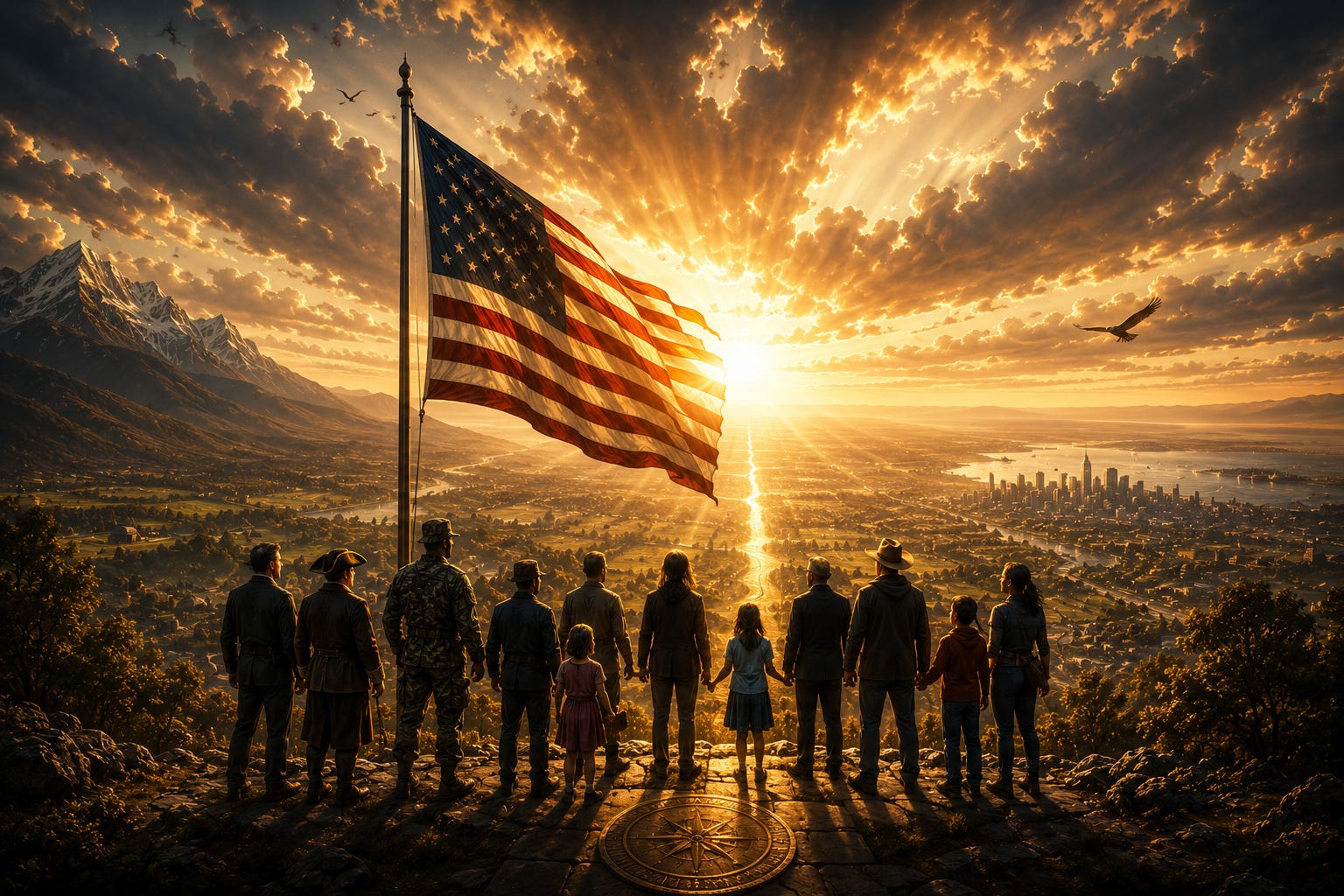
Before the Slogans
Remembering the Original Purpose of the American Experiment

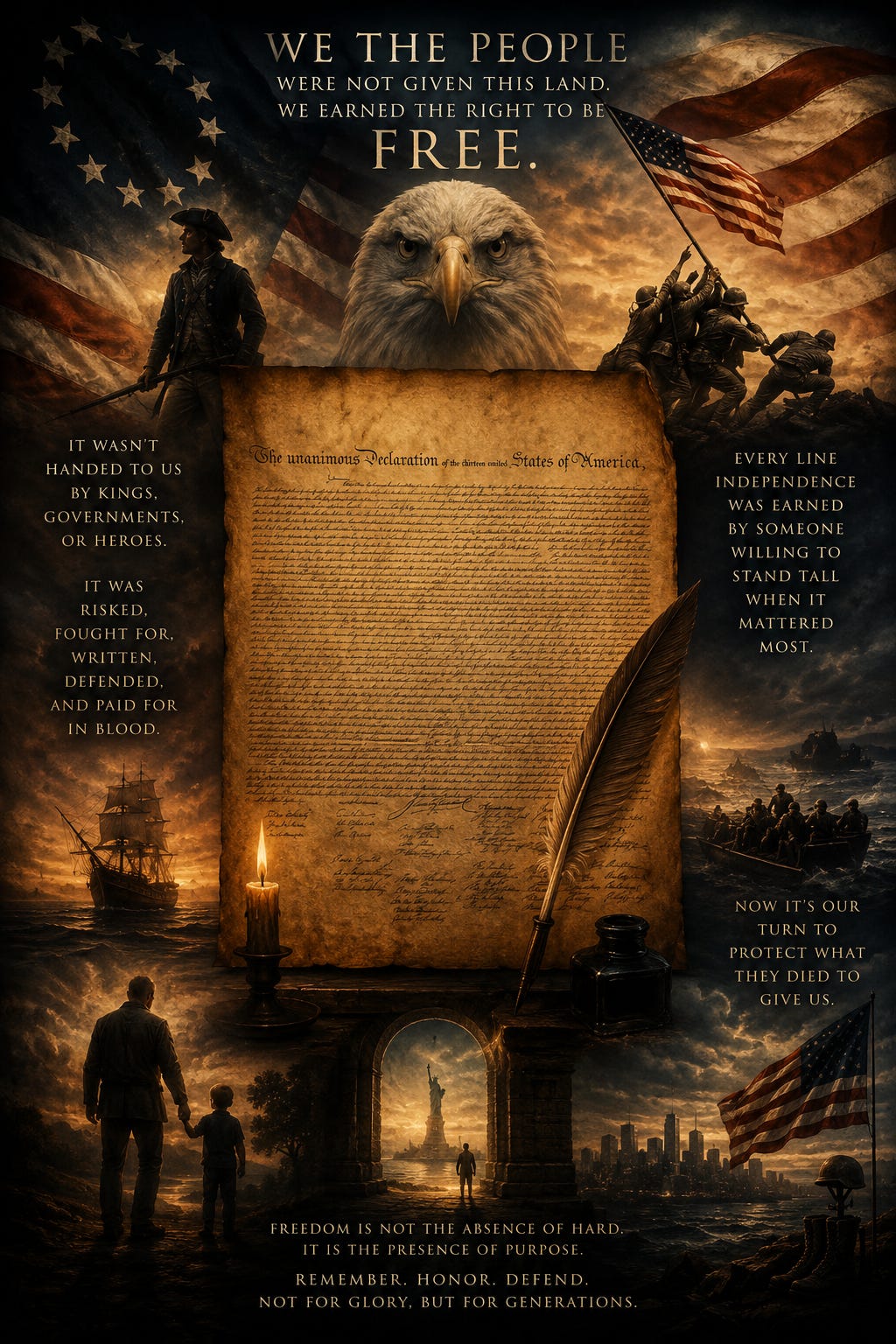
Every generation inherits a country, but no generation inherits the understanding that created it. That understanding must be rediscovered, questioned, defended, and improved by each new set of citizens. On the Fourth of July, fireworks often become louder than history, celebrations become louder than reflection, and symbols become louder than the principles they were meant to represent. The result is a nation that remembers the date but slowly forgets the reason.
The American experiment did not begin as a promise that everything would always go well. It did not begin with the expectation that government would solve every problem, nor with the belief that leaders should be worshipped, nor with the assumption that one political party would permanently represent truth. It began with a remarkably dangerous idea: that legitimate government exists to serve the people rather than the people existing to serve government.
That single reversal changed history.
When representatives of the thirteen colonies approved the Declaration of Independence on July 4, 1776, they were not simply announcing separation from Britain. They were attempting to justify that decision before the world. They argued that governments derive "their just powers from the consent of the governed." That phrase remains one of the most revolutionary political statements ever written.
Notice what it does not say.
It does not say governments receive unlimited authority because they are powerful.
It does not say citizens exist to obey without question.
It does not say rulers become morally correct simply because they occupy high office.
Instead, authority is presented as something delegated by the people, not owned by those who govern.
That distinction matters just as much today as it did nearly two and a half centuries ago.
The Declaration also states that people possess certain rights that governments do not create. Whether someone grounds those rights in natural law, philosophy, religious belief, or another moral framework, the argument is the same: rights exist before political institutions. Governments are formed to help secure those rights, not invent them.
That means freedom is not a gift handed down by officials.
It is a condition that government is expected to respect.
This is why the Declaration contains one of its most discussed passages—that when government becomes destructive of these ends, the people possess the authority to alter or abolish it and establish new safeguards for their future security and happiness. This was not written to encourage constant revolution or political instability. The authors themselves argued that governments should not be changed for "light and transient causes." Their point was that political power ultimately remains accountable to the people.
Responsibility accompanies that freedom.
Liberty without responsibility eventually becomes chaos.
Authority without accountability eventually becomes tyranny.
The American system was designed to exist between those extremes.
This is also why the Constitution that followed divided power rather than concentrating it. Executive, legislative, and judicial branches were intentionally placed in tension with one another. Federal and state governments were given separate responsibilities. Regular elections ensured that authority could change hands peacefully.
None of this was built on the assumption that human beings become perfect once elected.
Quite the opposite.
Many of the founders repeatedly warned that human beings remain ambitious, imperfect, emotional, and susceptible to corruption. Their solution was not to search for perfect leaders but to design imperfect institutions that limited everyone's power.
That is an important difference.
The Constitution was never meant to create saints.
It was designed to restrain ordinary human nature.
Over time, however, symbols often become easier to remember than ideas.
National mottos changed.
Traditions evolved.
The phrase "In God We Trust," familiar on American currency today, was adopted long after the nation's founding and eventually became the official national motto in the twentieth century. Likewise, many patriotic customs that feel timeless are actually products of later generations. None of that erases their significance for those who value them, but it reminds us that symbols evolve while the founding documents remain available for every generation to read firsthand.
That distinction is worth remembering.
The Declaration of Independence still says what it said.
The Constitution still says what it says.
Neither document requires mythology to remain historically important.
The original American experiment also assumed something modern society sometimes overlooks: citizens themselves would need wisdom. No constitutional system can permanently compensate for a population unwilling to think critically, examine evidence, disagree respectfully, and remain informed.
Freedom is demanding.
It asks people to make decisions instead of waiting for instructions.
It asks neighbors with different opinions to share the same society.
It asks citizens to tolerate disagreement without abandoning mutual respect.
Those requirements are not weaknesses.
They are the price of self-government.
History shows that republics rarely disappear overnight. More often, they erode gradually as citizens surrender responsibilities they once considered essential. Participation declines. Curiosity fades. Institutions become either blindly trusted or reflexively rejected instead of thoughtfully examined. Political opponents cease being fellow citizens and become permanent enemies.
When that happens, everyone loses.
The founders disagreed with one another constantly. They argued fiercely over economics, federal authority, foreign policy, banking, constitutional interpretation, and nearly every significant question facing the young nation. Yet despite those disagreements, they attempted to build procedures capable of surviving future conflict.
That may be one of their greatest achievements.
Not unanimity.
Durability.
The American experiment was never intended to eliminate disagreement.
It was intended to keep disagreement from destroying the republic.
That lesson remains surprisingly relevant.

Every generation faces its own challenges that earlier generations could scarcely imagine. New technologies transform communication. Artificial intelligence reshapes work. Information spreads globally in seconds. Financial systems evolve. Scientific understanding expands. Yet despite these enormous changes, one question remains remarkably consistent:
Who ultimately governs?
The founding answer was simple.
The people.
Not perfectly.
Not effortlessly.
But intentionally.
That answer carries another obligation.
If the people possess ultimate authority, then the quality of government cannot be separated from the quality of citizenship. A disengaged population eventually produces disengaged leadership. An informed population creates pressure for accountability. A curious population asks difficult questions. A complacent population slowly stops asking any.
Freedom therefore depends not only on constitutions but on culture.
It depends on parents teaching children.
Teachers encouraging questions.
Neighbors helping neighbors.
Communities solving problems together.
People reading original documents instead of relying entirely on summaries, slogans, or headlines.
Perhaps that is the greatest challenge of the modern era.
Information has become abundant.
Understanding has not.
The easiest path is allowing someone else to interpret history, define reality, and decide which questions deserve asking.
The harder path is opening the documents ourselves.
Reading them.
Comparing claims against evidence.
Accepting complexity where it exists.
Correcting mistakes when new evidence appears.
That process never truly ends.
It is the work of free citizens.
So today, whether you celebrate with family, watch fireworks, grill in the backyard, travel, work, or simply enjoy a quiet evening, consider returning to the beginning—not merely the celebration, but the ideas.
Read the Declaration.
Read the Constitution.
Read the Bill of Rights.
Agree with every word or not, but know what they actually say.
Because nations are not ultimately held together by fireworks, flags, songs, or slogans.
They are held together by shared principles, honest debate, mutual responsibility, and citizens willing to protect the liberty they inherited while improving it for those who come after them.
That may be the original purpose worth celebrating.
Not perfection.
Not partisanship.
Not personalities.
The enduring belief that free people are capable of governing themselves—and that each generation has both the privilege and the responsibility to prove that belief worthy of the sacrifices made before them.
Happy Independence Day.
May we continue to value not only the freedom to speak, but the wisdom to listen; not only the right to disagree, but the discipline to seek truth; and not only the inheritance of liberty, but the responsibility to preserve it.
💥🎉🫡🇺🇸🦅🍻🎉💥