
The Difference Between a Mistake and Evil
One is born from limitation. The other begins where awareness meets intention.

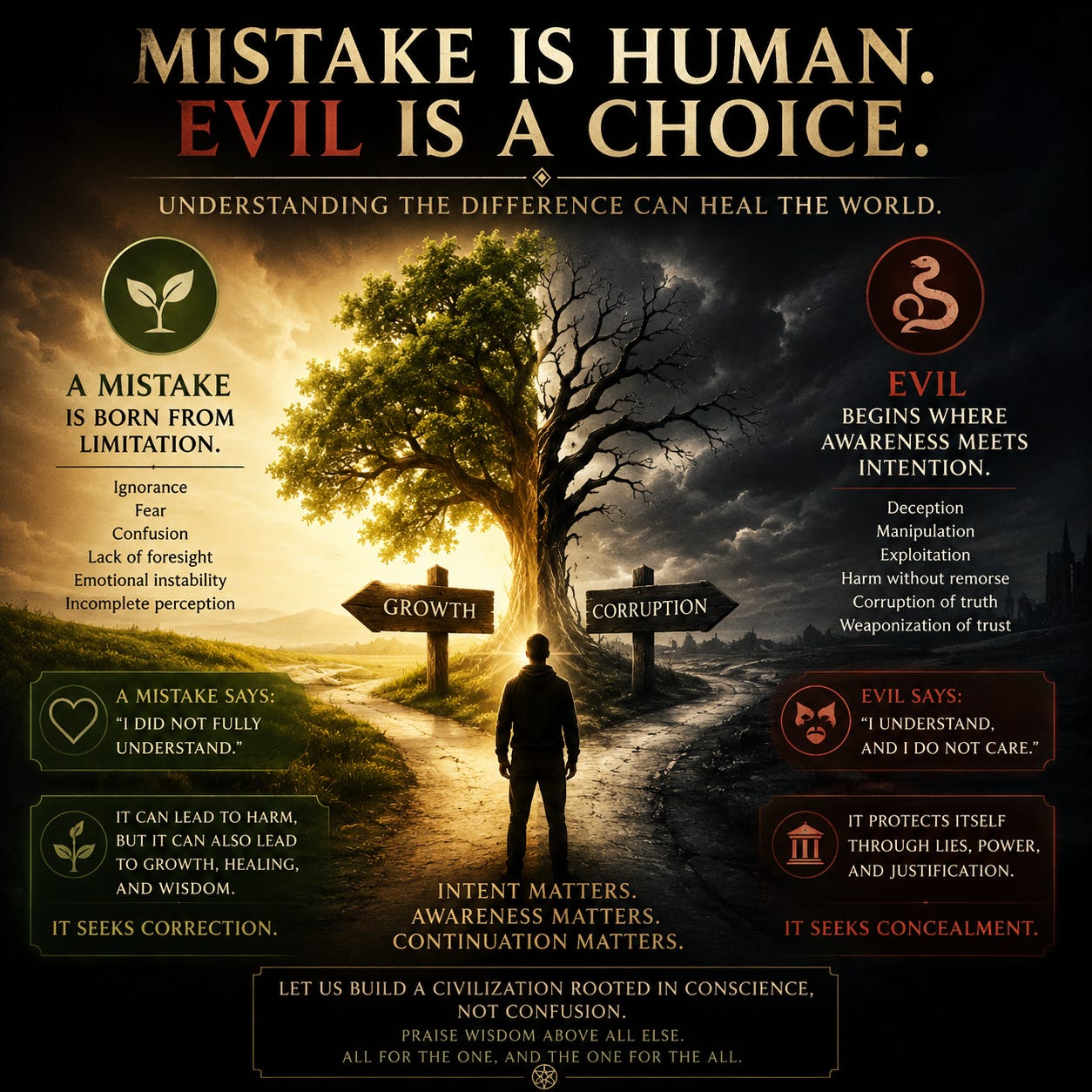
There is a difference between a mistake and evil. Humanity lost that distinction somewhere along the way, and the consequences have echoed through families, governments, religions, science, and civilization itself ever since.
A mistake is often born from limitation: ignorance, fear, confusion, immaturity, misunderstanding, lack of foresight, emotional instability, or incomplete perception.
A mistake can cause harm, sometimes tremendous harm, without the person fully comprehending the depth of what they were doing. Humanity learns through error. Every child touches the fire before understanding heat. Every civilization experiments before understanding consequence. Mistakes are tied to incompleteness.
Evil is different.
Evil begins where awareness meets intention.
It is the conscious continuation of harm after truth becomes visible.
It is deception used deliberately. Manipulation without remorse. Exploitation for personal gain while understanding the suffering created. The destruction of innocence knowingly. The corruption of truth intentionally. The weaponization of trust. The sacrifice of future generations for temporary power.
A mistake says: “I did not fully understand.”
Evil says: “I understand, and I do not care.”
That distinction matters more than modern society wants to admit.
Because many people who made mistakes can heal, grow, apologize, evolve, and become wiser. Some of the greatest humans in history were deeply flawed people who learned through failure, pain, and self-confrontation.
But evil resists self-correction because it protects itself through justification.
That is why ancient wisdom traditions focused so heavily on conscience.
The true battlefield was never merely external. It was internal.
Every human carries the capacity for: compassion or cruelty, honesty or manipulation, discipline or indulgence, humility or self-worship.
The danger begins when people stop examining themselves honestly.
A civilization that cannot distinguish between ignorance and malice eventually becomes incapable of justice. It either excuses genuine corruption or destroys imperfect people who were capable of growth.
Modern systems increasingly confuse: accidents with attacks, weakness with wickedness, questions with rebellion, and disagreement with hatred.
But nature itself shows a difference between instability and corruption.
A storm destroys without hatred. A child breaks something without malice. An exhausted mind can make terrible decisions without evil intent.
Intent matters.
Awareness matters.
Continuation matters.
The person who accidentally harms someone and feels genuine remorse is not the same as the person who repeatedly harms others while hiding behind excuses, systems, status, ideology, or power.
One seeks correction. The other seeks concealment.
And this is where civilization becomes dangerous: when entire systems begin rewarding conscious harm while punishing honesty.
When lies become profitable. When exploitation becomes normalized. When manipulation becomes policy. When conscience becomes weakness. When truth becomes a threat to institutions.
That is no longer mere human imperfection.
That becomes organized corruption.
The ancients understood this better than many modern societies do. Nearly every wisdom tradition warned that the greatest danger to humanity was not ignorance itself, but intelligence severed from morality.
Knowledge without wisdom. Power without restraint. Authority without accountability. Desire without discipline.
Those combinations repeatedly produce the darkest chapters in human history.
And still, many people misunderstand evil completely.
Evil is not always loud. Not always monstrous. Not always violent at first.
Sometimes it appears charming. Sophisticated. Educated. Successful. Polished. Institutionalized.
Some of history’s greatest atrocities were committed by people wearing suits, titles, uniforms, and symbols of authority while convincing themselves they were justified.
That is why self-awareness matters more than image.
The most dangerous humans are often not the emotional ones, but the emotionally disconnected ones who can harm others without internal resistance.
A mistake can become wisdom. Suffering can become compassion. Failure can become transformation.
But evil begins when a person repeatedly chooses harm while fully aware of its consequences.
That is the line humanity keeps pretending does not exist.
And until civilization learns the difference again, it will continue confusing broken people with malicious ones while allowing truly destructive behavior to hide behind systems, credentials, popularity, and power.
The future will not survive on intelligence alone.
It will survive on conscience.
Praise Wisdom above all else. All for the One, and the One for the all.